How to Lose Belly Fat: What Works and What Doesn't
You cannot burn fat from your belly alone. How to lose belly fat with a calorie deficit, protein, strength training and cardio, and how to measure it.
 Greg, Cal Clark team7 min read
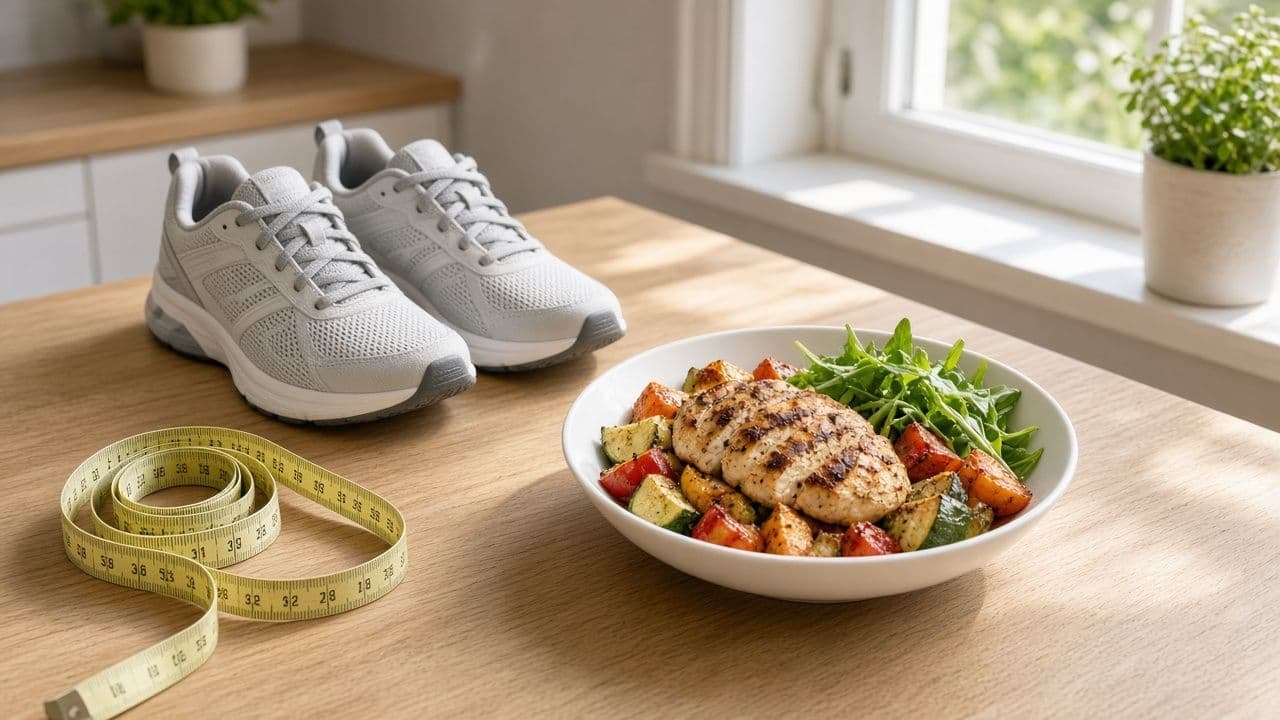
To lose belly fat, you need to lose body fat overall: eat a little less than you burn, keep your protein up, lift weights twice a week and add regular cardio. You cannot choose where your body takes fat from, so crunches alone will not flatten your belly. A tape measure shows your progress better than the scale.
Key takeaways
- Spot reduction does not work: in a 6-week trial, daily ab exercises did not reduce belly fat.
- A calorie deficit of about 500 kcal a day removes fat from everywhere, your belly included.
- Cardio reduces the deep fat around your organs, even without a diet.
- Track your waist, not only your weight. Keep it under half your height.
Can you lose fat from your belly only?
No. Your body decides where it takes fat from, and exercising one area does not burn the fat on top of it. In a trial with 24 adults, one group did 7 ab exercises, 2 sets of 10, five days a week for six weeks. They managed more curl-ups at the end, but their belly fat, waist size and body fat did not change compared with the group that did no exercises.
What works is the same as for any fat loss:
- Eat about 500 kcal a day less than you burn.
- Eat enough protein.
- Do strength training at least twice a week.
- Add cardio, such as brisk walking or cycling, most days.
Cal Clark sets calorie and macro targets for the goal you pick, and it is coming soon to iOS and Android: join the waitlist.
The two kinds of belly fat
Belly fat comes in two kinds. Subcutaneous fat sits under the skin; it is the fat you can pinch. Visceral fat sits deeper, around your organs, and you cannot pinch it.
A large waist is a sign of more fat around the middle. The US National Heart, Lung, and Blood Institute lists a waist above 102 cm (40 in) for men and 88 cm (35 in) for women as a marker of higher risk of disease in adults with overweight or obesity.
Both kinds usually shrink when you lose fat overall, and visceral fat also shrinks with cardio (Step 3).
How to measure belly fat at home
A tape measure tells you more about belly fat than a bathroom scale. The NHS advises that you try to keep your waist size to less than half your height. If you are 170 cm tall, that means a waist under 85 cm.
To measure, follow the method in the NHLBI guideline:
- Stand up straight and find the top of your hip bone at the side.
- Wrap the tape around your belly just above it, parallel to the floor.
- Pull it snug, but do not press into the skin.
- Read it after you breathe out normally.
Measure every 2 to 4 weeks, at the same time of day. Your waist moves slower than your weight, so short checks only show noise.
Step 1: Eat a little less than you burn
Fat loss starts with a calorie deficit: eating fewer calories than your body burns, so it uses stored fat for the rest. The NHS suggests losing 0.5 to 1 kg a week, and a deficit of about 500 kcal a day is a sensible start for most adults. The calorie deficit guide shows how to choose the size, and the calorie calculator works out your maintenance calories.
No food burns belly fat, and no diet targets the belly. Any way of eating that keeps you in a deficit, and that you can stick to, will shrink your waist over time.
Step 2: Keep protein up and lift weights
When you eat less, you want to lose fat, not muscle. Protein and strength training both help.
- The International Society of Sports Nutrition gives 1.4 to 2.0 g of protein per kg of body weight a day for active people. The protein per day guide turns this into meals.
- In a meta-analysis of older adults with obesity, adding resistance training to a lower-calorie diet prevented about 93% of the lean mass loss seen with the diet alone.
- The NHS recommends strengthening activities on at least 2 days a week, with weights, bands or your own body weight.
Ab exercises are fine as part of this. They strengthen your core; they just do not remove the fat on top.
Step 3: Add cardio for the deep fat
Cardio is the exercise most linked to less visceral fat. A meta-analysis of 15 studies with 852 people found that exercise without a diet reduced visceral fat in adults with overweight, and that aerobic training of moderate or high intensity worked best. Some programs showed the effect after 12 weeks.
The NHS advises at least 150 minutes of moderate activity or 75 minutes of vigorous activity a week. Brisk walking, cycling, swimming or a dance class all count.
Step 4: Find the calories you don't notice
A deficit only works if your log matches what you eat. Cooking oil, sauces, drinks and bites while you cook are easy to miss, and the guide to calories for weight loss shows how big those gaps can get.
In Cal Clark, you snap the plate and then add what the photo can't see, such as the oil or the dressing, so the meal is logged in one go.
Worked example
This is a calculation with the formula, not a real person.
A woman, 45, 165 cm, 78 kg, waist 90 cm. She starts walking most days and lifting twice a week.
| Number | |
|---|---|
| Waist-to-height ratio: 90 ÷ 165 | 0.55 (above the NHS 0.5 line) |
| Waist goal: half her height | under 82.5 cm |
| Resting energy: 10 × 78 + 6.25 × 165 - 5 × 45 - 161 | 1,425 kcal |
| Maintenance: 1,425 × 1.55 (the factor our calculator uses for moderate activity) | about 2,210 kcal |
| Deficit | 500 kcal |
| Daily target | about 1,710 kcal |
She can expect roughly 0.45 kg a week in the first weeks, and less later. She measures her waist every 4 weeks and works out her maintenance calories again as she loses weight, because a lighter body burns less, as Kevin Hall's model in The Lancet shows.
Where this does not work
- A belly that changes size during the day can be bloating, not fat. If it hurts, or stays for weeks, see your doctor.
- After pregnancy, a belly that does not flatten can come from separated stomach muscles. Ask your doctor or a physiotherapist before hard core training.
- Medical conditions and medicines can change weight and where fat sits. If you are pregnant, breastfeeding, under 18, take medication for diabetes, have kidney disease or have had an eating disorder, talk to your doctor before you cut calories or raise your protein.
Frequently asked questions
How long does it take to lose belly fat?
There is no fixed timeline: it depends on how much fat you have to lose and how big your deficit is. At the NHS pace of 0.5 to 1 kg a week, give it a few months, and measure your waist every few weeks rather than every day.
Do crunches burn belly fat?
No. In a six-week trial, adults who did ab exercises five days a week got stronger abs but lost no belly fat compared with people who did no exercises. Crunches build muscle under the fat. A calorie deficit and cardio remove the fat.
Can walking reduce belly fat?
Probably. The NHS counts brisk walking as moderate activity, the intensity that reduced the deep fat around the organs in a meta-analysis of 15 studies. Walking also adds to the calories you burn, which makes a calorie deficit easier to keep.
What foods burn belly fat?
No food burns belly fat. Fat loss comes from eating fewer calories than you burn. Foods high in protein and fibre, such as eggs, yogurt, beans, lean meat and vegetables, make a deficit easier because they keep you full.
Why is belly fat so hard to lose?
You cannot choose where fat comes off, and the order differs from person to person. Keep the deficit, the strength training and the cardio going, and judge progress by your waist measurement over months.
Summary
You lose belly fat the same way you lose any fat: a steady calorie deficit, enough protein, strength training and cardio. Measure your waist every few weeks and aim for less than half your height. Next, set your deficit with the calorie deficit guide, find your daily target in the guide to calories for weight loss, and if progress stops, read why you stopped losing weight.
Sources
- Vispute SS, Smith JD, et al. The effect of abdominal exercise on abdominal fat. Journal of Strength and Conditioning Research, 2011.
- Vissers D, Hens W, et al. The effect of exercise on visceral adipose tissue in overweight adults: a systematic review and meta-analysis. PLoS One, 2013.
- National Heart, Lung, and Blood Institute. Clinical guidelines on the identification, evaluation, and treatment of overweight and obesity in adults. 1998.
- NHS. Obesity.
- NHS. Bloating.
- NHS. Obesity: treatment.
- NHS. Physical activity guidelines for adults aged 19 to 64.
- Jäger R, Kerksick CM, et al. ISSN position stand: protein and exercise. JISSN, 2017.
- Sardeli AV, et al. Resistance training prevents muscle loss induced by caloric restriction in obese elderly individuals. Nutrients, 2018.
- Hall KD, Sacks G, et al. Quantification of the effect of energy imbalance on bodyweight. The Lancet, 2011.
This article is general information, not medical advice. Talk to a doctor or a registered dietitian before you make big changes to your diet.
Log your meals with a photo.
Cal Clark shows calories and macros in seconds. Join the waitlist and we'll tell you when the app goes live.
3-day free trial. No ads.