How Many Calories Should I Eat to Gain Muscle? Your Numbers
Eat about 10-20% above your maintenance calories and gain 0.25-0.5% of body weight a week. How many calories you should eat to gain muscle, with examples.
 Greg, Cal Clark team10 min read
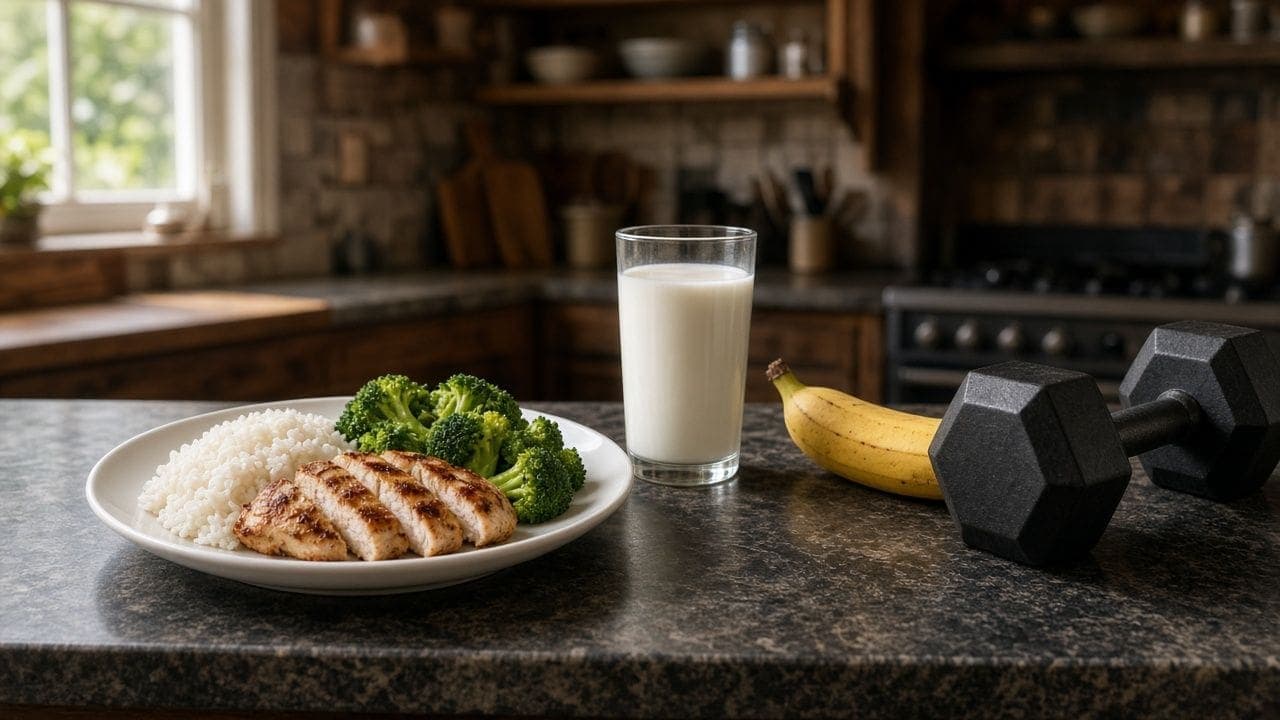
How many calories should you eat to gain muscle? About 10 to 20% more than your body burns in a day, which for most lifters is roughly 250 to 500 kcal above maintenance. A 2019 review of nutrition for natural bodybuilders pairs that surplus with a weight gain of about 0.25 to 0.5% of your body weight a week. Lift weights, eat enough protein, and check your weekly average weight to adjust.
Key takeaways
- Start from your maintenance calories, then add 10 to 20%.
- Aim to gain about 0.25 to 0.5% of your body weight a week. Experienced lifters should stay at the low end.
- In one trial of young elite athletes, extra food added fat, not muscle.
- Eat 1.6 to 2.2 g of protein per kg of body weight and train each muscle at least twice a week.
How many calories should I eat to gain muscle?
Eat your maintenance calories plus 10 to 20%. Maintenance calories, also called TDEE (total daily energy expenditure), are what you burn in a full day. For a 75 kg man with maintenance of about 2,720 kcal, that means about 3,000 to 3,250 kcal a day. For a 60 kg woman with maintenance of about 2,060 kcal, it means about 2,270 to 2,470 kcal.
| Step | What to do |
|---|---|
| 1. Maintenance | Work out your TDEE with a calculator or by hand |
| 2. Surplus | Add 10 to 20% (roughly 250 to 500 kcal) |
| 3. Protein | 1.6 to 2.2 g per kg of body weight a day |
| 4. Check | Weigh daily, compare weekly averages, adjust after 2 to 3 weeks |
Cal Clark sets calorie and macro targets for the goal you pick, including gaining mass. It is coming soon to iOS and Android: join the waitlist.
What is a calorie surplus?
A calorie surplus means you eat more energy than your body uses. A surplus gives your body spare energy for new muscle. Without lifting, the spare energy mostly adds fat. In a deficit, the opposite happens: you eat less than you burn, as the calorie deficit guide explains.
A surplus does not have to be big. The 2019 review recommends about 10 to 20% above maintenance for beginners and intermediate lifters. A 2019 review in Frontiers in Nutrition says nobody knows the exact surplus that builds the most muscle, and advises starting carefully at about 1,500 to 2,000 kJ a day (roughly 360 to 480 kcal), then adjusting from how your body responds.
Step 1: Find your maintenance calories
Your maintenance calories are your resting energy times an activity factor. Our TDEE calculator does the sum for you with the Mifflin-St Jeor equation, the formula the calorie calculator uses too. The guide to calories for weight loss shows the same formula by hand.
Treat the result as a starting estimate. Two people with the same age, height and weight can burn a few hundred kcal apart, so your weight trend over the next weeks is the real test.
Step 2: Choose how fast to gain
Your weekly weight gain shows whether your surplus fits. The bodybuilding review suggests about 0.25 to 0.5% of body weight a week for novice and intermediate lifters, and says advanced lifters should be more conservative.
| Body weight | Gain per week (0.25 to 0.5%) | Gain per month, about |
|---|---|---|
| 55 kg (121 lb) | 0.14 to 0.28 kg | 0.6 to 1.2 kg |
| 65 kg (143 lb) | 0.16 to 0.33 kg | 0.7 to 1.4 kg |
| 75 kg (165 lb) | 0.19 to 0.38 kg | 0.8 to 1.6 kg |
| 90 kg (198 lb) | 0.23 to 0.45 kg | 1.0 to 2.0 kg |
New lifters can aim for the upper half of the range. After a few years of steady training, muscle comes more slowly, so the lower half fits better.
Worked examples
These are calculations with the formula, not real people.
A man, 25, 180 cm, 75 kg, lifts 4 days a week.
| kcal a day | |
|---|---|
| Resting energy: 10 × 75 + 6.25 × 180 - 5 × 25 + 5 | 1,755 |
| Maintenance: 1,755 × 1.55 (the factor our calculator uses for moderate activity) | about 2,720 |
| Surplus of 10 to 20% | 270 to 545 |
| Daily target | about 3,000 to 3,250 |
He aims to gain about 0.2 to 0.4 kg a week, and eats 120 to 165 g of protein a day (1.6 to 2.2 g/kg).
A woman, 28, 165 cm, 60 kg, lifts 3 days a week.
| kcal a day | |
|---|---|
| Resting energy: 10 × 60 + 6.25 × 165 - 5 × 28 - 161 | 1,330 |
| Maintenance: 1,330 × 1.55 (the factor our calculator uses for moderate activity) | about 2,060 |
| Surplus of 10 to 20% | 205 to 410 |
| Daily target | about 2,270 to 2,470 |
She aims to gain about 0.15 to 0.3 kg a week, and eats about 95 to 130 g of protein a day.
Why a bigger surplus does not build more muscle
Eating far more than you need speeds up the scale, but the extra weight is mostly not muscle. In a study of 39 young elite athletes over 8 to 12 weeks of strength training, one group followed a meal plan with a clear surplus and ate about 3,585 kcal a day, while the other ate freely at about 2,964 kcal. The meal-plan group gained more body weight (3.9% against 1.5%) and more fat mass (15% against 3%), but their gain in lean mass was not different.
In that trial, the extra food added fat without adding muscle, which is why a modest surplus is the safer start.
Protein, carbs and fat while you gain
Your total calories set how fast you gain, and your protein, carbs and fat shape what you gain.
- Protein: 1.6 to 2.2 g per kg a day. That is the range in the 2019 review. A meta-analysis of 49 studies found that muscle gains levelled off at about 1.6 g/kg a day, with the upper end of its estimate near 2.2 g/kg, so you don't need huge amounts. The protein per day guide turns this into meals.
- Fat: 0.5 to 1.5 g per kg a day. That leaves room for enough carbs.
- Carbs: the rest, 3 to 5 g per kg a day or more. Carbs fuel hard training sessions, according to the same review.
For the 75 kg example above, that is about 120 to 165 g of protein, 40 to 110 g of fat and the rest from carbs.
Lift, or the surplus becomes fat
The surplus only turns into muscle when you train for it. The NHS advises strengthening activities for all major muscle groups on at least 2 days a week. For growth, more work helps: a meta-analysis on training volume found that each extra weekly set per muscle led to a little more growth, and groups doing 10 or more sets per muscle a week tended to grow the most.
Add weight or reps over time, so your muscles keep getting a reason to grow.
How to adjust your calories week by week
Your first target is a guess. Your weight trend tells you how good the guess was.
- Weigh yourself each morning, after the toilet and before breakfast.
- Compare weekly averages, not single days. Water and food in your gut move the scale up and down from day to day, as the calorie deficit guide explains.
- After 2 to 3 weeks (our rule of thumb, long enough for a trend), compare your average gain with the table above.
- Too slow: add a small snack a day, such as a glass of milk or a slice of toast with peanut butter, and check again in 2 weeks.
- Too fast: take a similar amount away.
The first week often shows a quick jump. More food and more carbs refill the glycogen (stored carbohydrate) in your muscles, and each gram of glycogen is stored with water, so do not read the first week as muscle.
Logging helps you hit a surplus on purpose. In Cal Clark, protein shows next to calories for every meal, so you can see both numbers at once.
If you struggle to eat enough
Some people find a surplus harder than a diet. Small, calorie-dense additions help more than bigger plates. According to USDA FoodData Central, these add up quickly:
- A tablespoon of olive oil on rice, pasta or salad: about 120 kcal.
- Two tablespoons of peanut butter on toast or in oats: about 190 kcal.
- A cup of whole milk with a meal: about 150 kcal.
Drinks count too. A smoothie with milk, a banana and oats is easier to finish than the same food on a plate.
Where this does not work
A surplus is not the right tool for everyone.
- If you also want to lose fat, a surplus is the wrong tool. Keep any deficit small while you lift: a meta-analysis on training in a deficit found that a deficit of about 500 kcal a day was on average enough to stop lean mass gains.
- Teenagers still growing, people who are pregnant or breastfeeding, people with kidney disease or who take diabetes medication, and anyone with a medical condition that affects weight should ask their doctor before changing how much they eat or raising their protein.
- If you have had an eating disorder, a plan built on weighing and tracking can do harm. Talk to your doctor or a registered dietitian first.
Frequently asked questions
Is a 500 calorie surplus too much?
For a beginner with high maintenance calories, 500 kcal can sit inside the 10 to 20% range. For a smaller or more experienced lifter it is often too much and adds fat faster. Check your weekly weight gain: if it is above 0.5% of your body weight, eat a little less.
How much weight should I gain per week to build muscle?
About 0.25 to 0.5% of your body weight a week, according to a 2019 review for natural bodybuilders. For a 70 kg person that is about 0.2 to 0.35 kg a week. Experienced lifters should stay at the lower end.
Can I gain muscle at maintenance calories?
Some muscle, yes, as long as you train hard and eat enough protein. Without a surplus your weight hardly moves, so track your strength and waist measurement as well. If muscle gain is your main goal, a small surplus makes it easier.
Should I eat more on training days?
You can, but you don't need to. A weekly average works fine for muscle gain. If you prefer more food on training days for energy, move some calories from rest days to training days and keep the weekly total the same.
How long should a bulk last?
A bulk is a planned phase of eating in a surplus. It has no fixed length; gaining for a few months and then holding your weight or cutting is a common pattern. If your waist grows much faster than your strength, or you gain faster than 0.5% a week for several weeks, it is time to slow down.
Summary
Start from your maintenance calories, add 10 to 20%, and aim to gain 0.25 to 0.5% of your body weight a week. Eat enough protein, train every muscle at least twice a week, and adjust every couple of weeks from your average weight. Next, set your exact protein target with the protein per day guide, get your maintenance from the TDEE calculator, and read how calorie targets work for weight loss for when you switch to a cut.
Sources
- Iraki J, Fitschen P, Espinar S, Helms E. Nutrition recommendations for bodybuilders in the off-season: a narrative review. Sports, 2019.
- Slater GJ, Dieter BP, et al. Is an energy surplus required to maximize skeletal muscle hypertrophy associated with resistance training? Frontiers in Nutrition, 2019.
- Garthe I, Raastad T, et al. Effect of nutritional intervention on body composition and performance in elite athletes. European Journal of Sport Science, 2013.
- Morton RW, Murphy KT, et al. A systematic review, meta-analysis and meta-regression of the effect of protein supplementation on resistance training-induced gains in muscle mass and strength. British Journal of Sports Medicine, 2018.
- Schoenfeld BJ, Ogborn D, Krieger JW. Dose-response relationship between weekly resistance training volume and increases in muscle mass. Journal of Sports Sciences, 2017.
- NHS. Physical activity guidelines for adults aged 19 to 64.
- Fernández-Elías VE, et al. Relationship between muscle water and glycogen recovery after prolonged exercise in the heat in humans. Eur J Appl Physiol, 2015.
- Murphy C, Koehler K. Energy deficiency impairs resistance training gains in lean mass but not strength. Scand J Med Sci Sports, 2022.
- USDA. FoodData Central.
This article is general information, not medical advice. Talk to a doctor or a registered dietitian before you make big changes to your diet.
Log your meals with a photo.
Cal Clark shows calories and macros in seconds. Join the waitlist and we'll tell you when the app goes live.
3-day free trial. No ads.