Meal Prepping for Weight Loss: A 90-Minute Plan
Meal prepping for weight loss: cook three bases in about 90 minutes, portion each box by calories and protein, and store it safely. Boxes with numbers.
 Greg, Cal Clark team8 min read
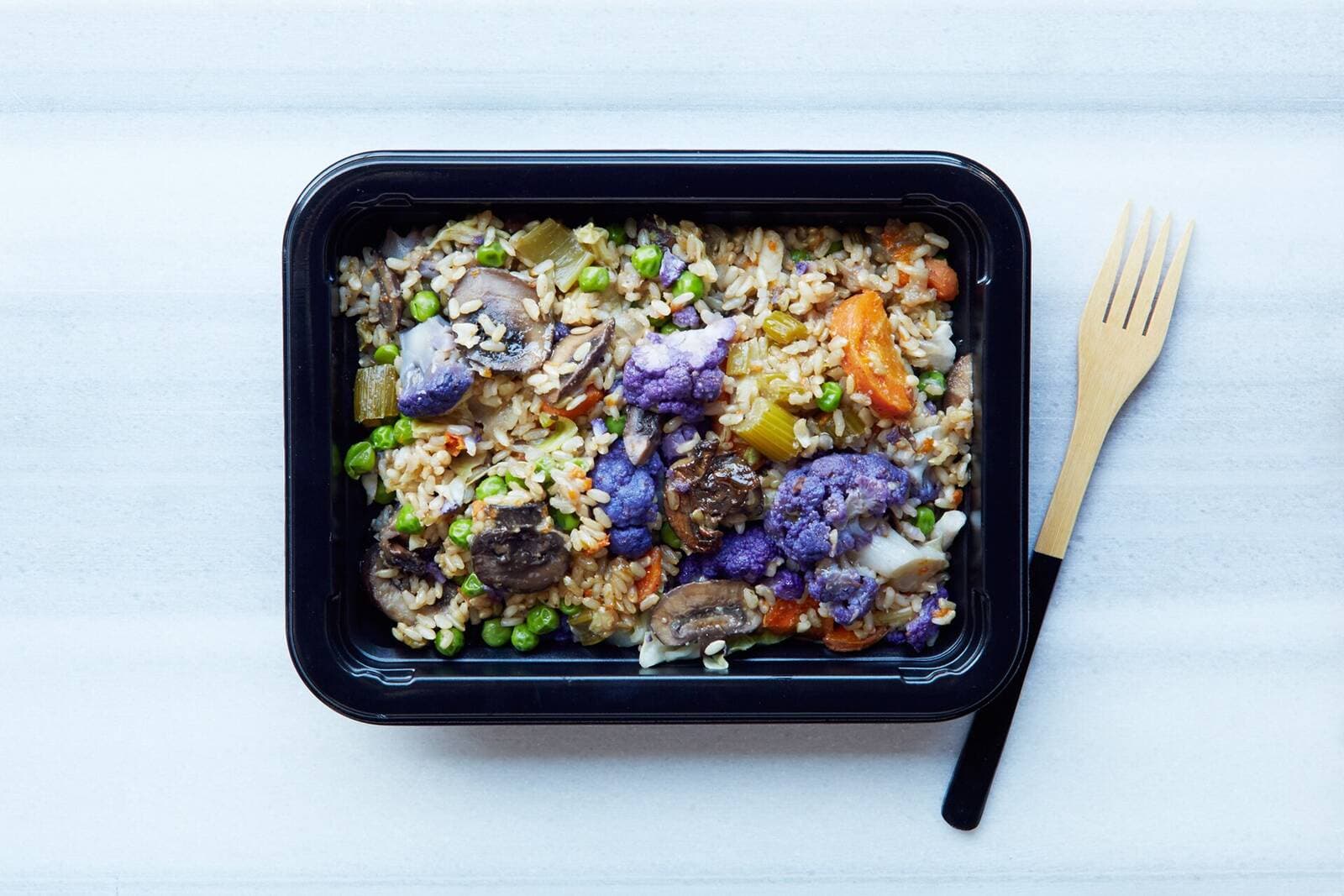
To meal prep for weight loss, cook a protein, a starch and a vegetable in one session, split them into boxes of a known size, and keep them cold until you eat them. Prepping does not cause weight loss by itself. It helps because each box has a number you chose in advance, so a busy evening does not decide your calories for you. One session of about 90 minutes can cover eight main meals and four breakfasts.
Key takeaways
- Weight loss still comes from eating fewer calories than you burn. Prep is a way to hit that target on busy days.
- Build each box from a protein, a starch and a vegetable, and weigh the cooked portions once.
- Cool cooked food and refrigerate it within 2 hours, and reheat it to 165°F (74°C).
- Log a prepped box once, save it, and reuse the same numbers all week.
How do you meal prep for weight loss?
You work in five steps: set a calorie and protein target per meal, choose a protein, a starch and a vegetable, cook them in parallel, weigh the portions into boxes and chill them within 2 hours. The calorie target per meal comes from your daily target. Get that number from the calorie calculator or from our guide on how many calories to eat to lose weight, then divide it across the meals you plan to prep.
Does meal prep help you lose weight?
It can help, mainly because it makes tracking and portion control easier. A systematic review of self-monitoring in weight loss found a consistent link between tracking food and weight loss, and the authors also note that the level of evidence was weak because of the limits of the studies. If you do not yet log your food, how to track calories shows a simple routine.
How many calories and how much protein per box?
Take your daily calorie target and split it across your meals however suits your day. For protein, the ISSN position stand on protein and exercise gives 1.4-2.0 g per kg of body weight a day for most people who exercise. For a 70 kg adult, that is 98-140 g a day, so about 33-47 g in each of three meals. Our page on how much protein you need per day has the full table by weight and goal. The numbers below are an example of how a box can look, not a target for you. The lentil box has less protein than the range above, so add yogurt or an egg on the side to close the gap.
| Box | Cooked portions | Calories | Protein |
|---|---|---|---|
| Chicken, rice, broccoli | 120 g chicken breast, 150 g rice, 150 g broccoli, 5 g olive oil | about 490 kcal | about 45 g |
| Lentils, rice, broccoli | 200 g lentils, 100 g rice, 150 g broccoli, 5 g olive oil | about 459 kcal | about 24 g |
| Egg and yogurt breakfast | 2 hard-boiled eggs (100 g), 200 g plain low-fat Greek yogurt | about 301 kcal | about 33 g |
Source: USDA FoodData Central, SR Legacy entries per 100 g, checked 2026-11-01: chicken breast, cooked 165 kcal and 31.0 g protein, white rice, cooked 130 kcal and 2.69 g, lentils, boiled 116 kcal and 9.02 g, broccoli, boiled 35 kcal and 2.38 g, egg, hard-boiled 155 kcal and 12.6 g, plain low-fat Greek yogurt 73 kcal and 9.95 g, olive oil 884 kcal per 100 g. The values are for the cooked items listed, scaled to the portions in the table. Your recipe, brand and cooking method will differ a little.
A day built from the boxes above could be the egg and yogurt breakfast (301 kcal), the chicken box (490 kcal) and the lentil box (459 kcal), which is 1,250 kcal. The rest of your target goes to snacks, fruit, sauces and drinks.
What does a 90-minute prep session look like?
This is a plan you can follow with one oven, one hob and one cutting board.
- Minutes 0-10: heat the oven. Put the chicken breasts on a tray and season them. Start the rice and lentils in two pans.
- Minutes 10-15: put the chicken in the oven. Cut the broccoli.
- Minutes 15-40: while the chicken and the grains cook, boil the eggs in a third pan and cut the vegetables you want for snacks.
- Minutes 40-50: steam the broccoli.
- Minutes 50-70: check that the chicken is cooked through, rest it, then slice it. Weigh it.
- Minutes 70-90: weigh each portion into a box on a kitchen scale, add the oil, then spread the food out to cool before you close the lids.
Weigh the food after cooking and use the same scale every time. Cooked and raw weights differ, so a log made with raw weights and a box weighed cooked do not match. Our guide to counting calories without weighing everything covers what to do on days without a scale.
How do you store prepped meals safely?
Cool the food, refrigerate it quickly and reheat it fully. The CDC food safety guidance says to refrigerate cooked leftovers within 2 hours, or within 1 hour when the temperature is above 90°F (32°C), to keep the refrigerator at 40°F (4°C) or below, and to reheat leftovers to 165°F (74°C), checking with a food thermometer. It also gives 0°F (-18°C) or below for the freezer. For how many days each food keeps, use the official cold food storage chart and put the date on each box. Cook fewer boxes than you can eat inside that time and freeze the rest on the day you cook. Pregnant people, adults over 65, young children and people with weakened immunity should follow stricter official advice.
What should you prep first?
Start with the meals you skip or replace with takeaway, usually weekday lunches. Pick foods that survive the fridge and reheat well.
- Proteins: chicken breast, hard-boiled eggs, lentils, tofu, plain yogurt.
- Starches: rice, potatoes, pasta, oats.
- Vegetables: broccoli, carrots, peppers, green beans.
- Add on the day: salad leaves, fresh herbs, sauces and anything crisp.
Our high protein meals to lose weight page has more plates with grams of protein and calories.
How do you log prepped meals?
Log a box once and save it, then add the same entry every time you eat it. Cal Clark keeps saved meals with their numbers for next time, so a prepped lunch is one tap after the first entry. It is coming soon to iOS and Android: join the waitlist. If you change the recipe, change the grams of the item that changed and save it again.
A shopping list for one session
This list makes four chicken boxes, four lentil boxes and four breakfasts.
- Chicken breast, enough for 480 g cooked.
- Rice and lentils, enough for 1,000 g of cooked rice and 800 g of cooked lentils.
- Broccoli, enough for 1.2 kg cooked.
- Olive oil, about 40 g.
- 8 eggs.
- Plain low-fat Greek yogurt, 800 g.
- 12 food containers with lids.
Raw and cooked foods weigh differently, so read the package and buy a little extra rather than a little short.
Where this does not work
- A fixed menu can feel rigid. If you dislike eating the same box five days in a row, prep two kinds of box and decide the other meals on the day.
- If you have diabetes, kidney disease or a medical diet, ask your doctor or a registered dietitian before you set protein or calories.
- If you have had an eating disorder, do not set calorie targets or portions on your own.
- Meal prep does not make a calorie target correct. If the scale does not move after two weeks, check the target and your logging.
Frequently asked questions
Does meal prep help you lose weight?
It can, because it makes it easier to eat the portions you planned and to log them. Weight loss itself still depends on eating fewer calories than you burn.
How long does meal prep last in the fridge?
It depends on the food, so check the official cold food storage chart linked above and write the cooking date on each box. Cool and refrigerate cooked food within 2 hours, and freeze boxes you will not eat in time.
How many calories should a meal prep meal have?
Divide your daily calorie target by your meals. Use the calorie calculator to get the daily number first. The boxes above run from about 300 to 490 kcal as an example.
How much protein per meal when losing weight?
For most people who exercise, 1.4-2.0 g per kg of body weight a day is a common range. A 70 kg adult spreading that over three meals gets about 33-47 g per meal.
What are the best foods to meal prep for weight loss?
Chicken breast, eggs, lentils, plain yogurt, rice, potatoes and cooked vegetables keep well and are easy to weigh. Prep the sauces separately and add crisp foods on the day.
Summary
Meal prepping for weight loss works when each box has a calorie and protein number you chose in advance. Cook a protein, a starch and a vegetable in one 90-minute session, weigh the cooked portions, refrigerate within 2 hours and reheat to 165°F (74°C).
Related
- High protein meals to lose weight
- How to track calories: a simple routine for beginners
- How many calories should I eat to lose weight?
Sources
- Burke LE, Wang J, Sevick MA. Self-monitoring in weight loss: a systematic review of the literature. J Am Diet Assoc, 2011.
- Jäger R, Kerksick CM, et al. International Society of Sports Nutrition position stand: protein and exercise. J Int Soc Sports Nutr, 2017.
- CDC. Food safety prevention.
- USDA. FoodData Central.
This article is general information, not medical advice. Talk to a doctor or a registered dietitian before you make big changes to your diet.
Log your meals with a photo.
Cal Clark shows calories and macros in seconds. Join the waitlist and we'll tell you when the app goes live.
3-day free trial. No ads.